- By Admin
- 20 Sep, 2026
- Corporate
Guide to Choosing Wheels and Casters for Medical Equipment in Saudi Hospitals
Hospitals and healthcare facilities require mobility equipment that provides quiet operation, easy maneuverability, and stability, as medical equipment is constantly moved between patient rooms, corridors, and service areas.
Wheels and casters are small components that play an important role in the performance of many types of medical equipment, including hospital beds, equipment carts, medication carts, service tables, laboratory equipment, and various medical trolleys.
Therefore, choosing medical equipment wheels in Saudi Arabia should be based on the type of equipment and its intended use, rather than size or appearance alone.
Why Are Medical Equipment Wheels Important?
Medical equipment operates in environments that require a high level of control.
Users may need to:
- Move equipment easily.
- Change direction quickly.
- Secure equipment in place.
- Reduce noise.
- Protect floors.
- Move through narrow corridors.
- Maintain control of equipment during use.
WICKE explains that Equipment Casters are used in laboratories and medical technology, as well as in food, packaging, and logistics industries, with a focus on safe and quiet movement without leaving marks on floors.
Medical Equipment Wheels in Saudi Arabia: Key Selection Factors
When choosing medical wheels, the operating conditions should be identified first.
1. Equipment Weight
The weight of the equipment and its maximum load should be determined.
The required load capacity for each caster can then be calculated.
WICKE's guidelines for calculating caster capacity recommend considering the equipment weight and load together with a safety factor, with a suggested factor of 1.3–1.5 depending on floor conditions and operating requirements.
2. Floor Type
Hospitals generally require flooring that is suitable for continuous movement.
Floor protection and noise reduction can be important factors when selecting the appropriate wheel material.
3. Noise Level
Quiet movement is an important advantage in hospitals, especially near patient rooms.
Therefore, certain elastic or polyurethane wheels may be suitable for applications where noise reduction is required, depending on the wheel design.
4. Maneuverability
Some medical equipment needs to change direction easily, making Swivel Casters important.
For other equipment, combining fixed and swivel casters may provide a better balance between stability and maneuverability.
Hospital Wheels in Saudi Arabia: Fixed or Swivel?
The appropriate wheel type depends on the equipment.
Swivel Casters
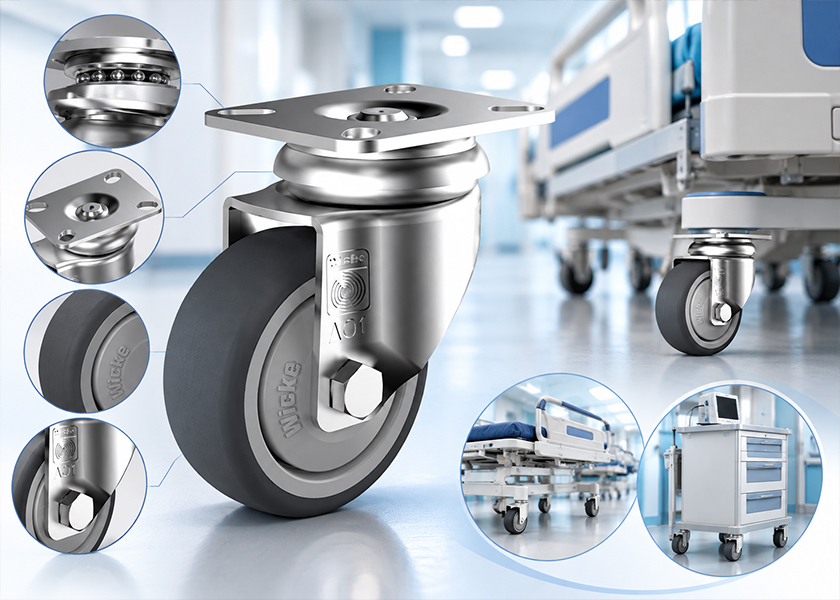
Swivel casters allow the equipment to change direction and are suitable for medical carts that need to maneuver through corridors.
Fixed Casters
Fixed casters move in a specific direction and can be used when straight-line movement is more important.
Swivel Casters with Brakes
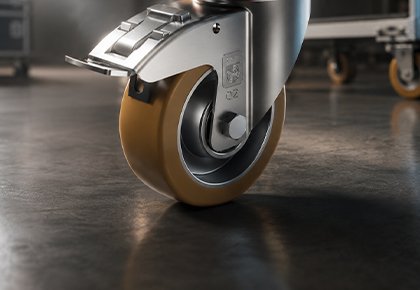
These combine easy maneuverability with the ability to secure the equipment in place.
WICKE explains that combining swivel casters, brakes, and fixed casters can provide precise steering and suitable stability for certain types of equipment.
Medical Bed Wheels in Saudi Arabia
Hospital beds are among the most important types of equipment requiring high-quality wheels.
Bed casters should provide:
- Easy movement.
- Appropriate load capacity.
- Good stability.
- Braking capability.
- Quiet operation.
- Maneuverability in limited spaces.
When choosing medical bed wheels in Saudi Arabia, make sure the casters are compatible with the bed's weight, load capacity, and intended use.
The Importance of Brakes in Medical Equipment
Many types of medical equipment need to remain stationary during use.
For this reason, casters with brakes are available to secure the wheel or related components, depending on the product design.
However, the appropriate brake system must be selected according to the equipment.
Available systems may include:
- Total Lock.
- Directional Lock.
- Wheel Brake.
The appropriate system should be selected based on how the equipment is used and the required level of stability.
Choosing Wheel Material for Hospitals
Medical wheels are available in different materials.
Polyurethane
Polyurethane can provide quiet movement and good wear resistance and may be suitable for certain medical flooring applications.
Rubber
Rubber provides flexibility and good vibration absorption in many applications.
Polyamide
Polyamide is characterized by hardness and wear resistance and can be used for certain medical equipment that requires a rigid wheel.
TPE
Certain TPE solutions can be used in equipment requiring quiet movement and flexibility, depending on the product and specifications.
There is no single wheel material suitable for all medical equipment.
Is Stainless Steel Suitable for Medical Equipment?
In environments requiring high corrosion resistance and easy cleaning, stainless steel components can be used in casters.
WICKE explains that stainless steel casters are suitable for environments requiring resistance to moisture and corrosion, including healthcare and food-related applications.
However, the appropriate stainless steel grade and specifications should be selected according to the requirements of the healthcare facility.
Calculating Load Capacity for Medical Casters
Suppose the equipment and its load have a total weight of 200 kg and four wheels are installed.
You should not simply divide 200 kg by 4 and select a wheel with a 50 kg capacity.
An appropriate safety factor should be added according to the operating conditions.
WICKE's guidelines provide an example using a factor of 1.3, making caster capacity selection safer than relying only on the theoretical load.
How Do You Choose the Right Wheel Diameter?
Wheel diameter depends on:
- Equipment weight.
- Floor type.
- Equipment height.
- Required ease of movement.
- Available space.
- Caster type.
Larger diameters may help under certain movement conditions, while smaller diameters may be more suitable for compact equipment.
The Importance of Bearings
The bearing affects starting movement, rolling resistance, and service life.
Wheels are available with different bearing types, including Plain, Roller, and Ball Bearings.
Therefore, the bearing type should be selected according to equipment weight, application requirements, and the required level of movement.
How Do You Maintain Medical Equipment Wheels?
Regular maintenance helps maintain performance.
The following should be inspected:
- Wheel surface.
- Brakes.
- Axles.
- Bearings.
- Mounting system.
- Wear.
- Cracks.
- Ease of movement.
- Noise level.
Wheels should also be cleaned according to the manufacturer's instructions, especially in healthcare facilities that follow specific cleaning and sanitation protocols.
One Step Wheel Solutions for the Healthcare Sector
One Step offers a Healthcare & Pharma category that includes various wheel and caster options for healthcare applications.
When choosing medical equipment wheels in Saudi Arabia, the equipment type, weight, floor conditions, movement requirements, and braking needs should be identified before selecting the appropriate product.
Frequently Asked Questions
What Are the Best Wheels for Medical Equipment?
The choice depends on the equipment type, weight, floor surface, noise requirements, maneuverability, and braking needs.
What Are the Best Wheels for Hospital Beds?
They should be selected according to the bed's weight and load capacity, while considering ease of movement, braking, quiet operation, and stability.
Are Swivel Casters Better for Hospitals?
They are useful for equipment that needs to change direction and maneuver easily. However, some equipment may benefit from a combination of swivel and fixed casters.
Is Stainless Steel Suitable for Medical Equipment?
It can be suitable for environments requiring corrosion resistance and easy cleaning, provided that the appropriate type and specifications are selected.
How Do I Calculate the Load Capacity of Medical Equipment Wheels?
Calculate the total equipment and load weight, apply an appropriate safety factor, and distribute the load across the number of wheels while considering how the weight is actually distributed.
Conclusion
Choosing medical equipment wheels in Saudi Arabia requires careful consideration of equipment weight, floor type, noise level, maneuverability, and braking requirements.
Hospital wheels in Saudi Arabia and medical bed wheels in Saudi Arabia should be selected according to the actual application, as the requirements of a hospital bed differ from those of an equipment cart or medication trolley.
The right solution should combine adequate load capacity, smooth movement, stability, and floor protection while bein